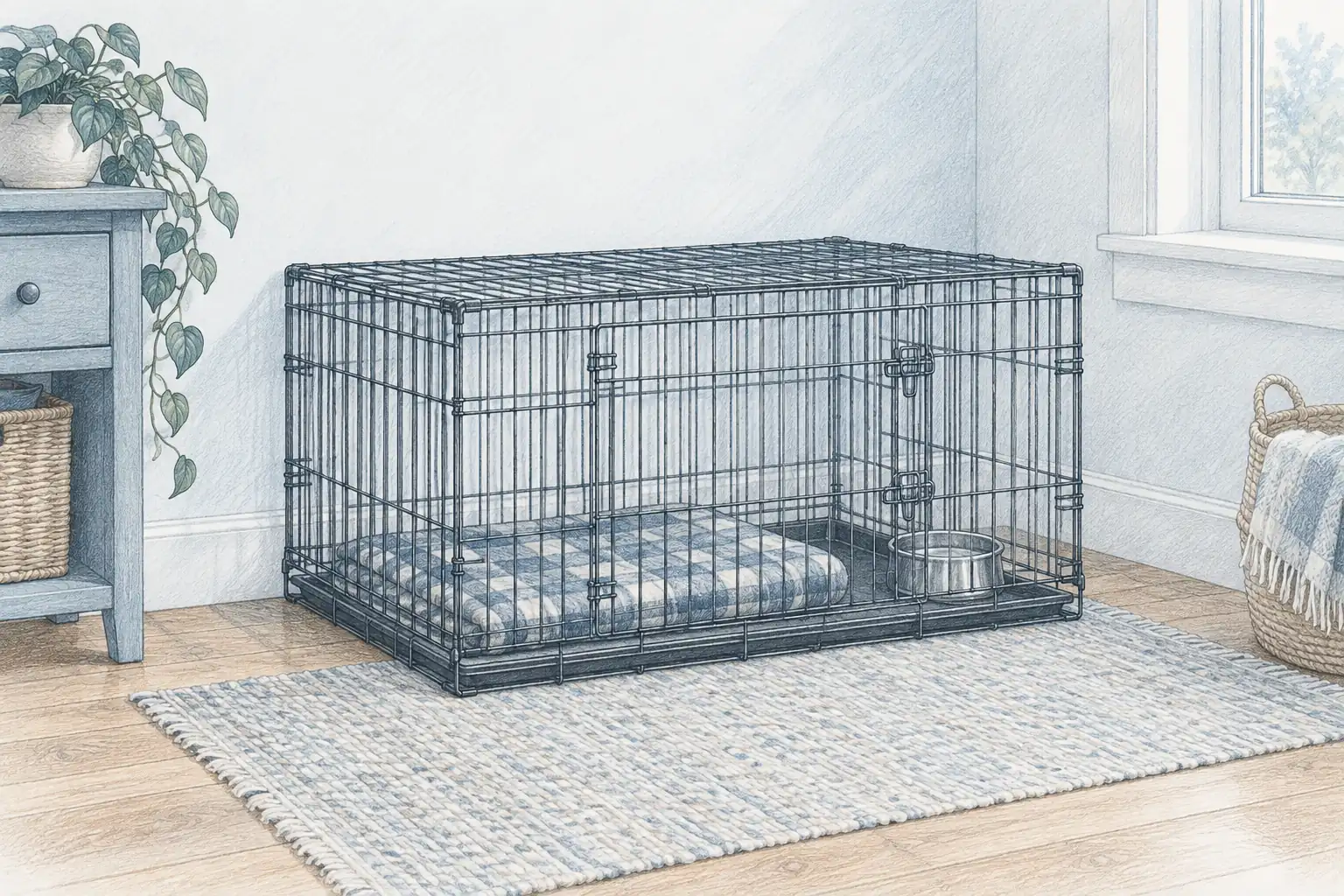
Dog Kennel for Large Dogs (2026): 36 and 48-Inch Picks That Fit
Beds and crates
The best dog kennel for a large dog is the Midwest 36-Inch iCrate, the length that fits a 41 to 70 pound dog without wasting floor. A dog over 90 pounds gets the FDW 48-inch double door, a 50 to 70 pound dog that flies gets the Petmate Sky Kennel, and the 24-inch is the size a large dog should not be in.
Our picks
A kennel for a large dog is decided by one number: the length that lets your dog stand without hitting the top, turn around, and lie down flat. Style comes second. A 36-inch frame suits most 41 to 70 pound dogs, and a 48-inch frame is the usual answer once a dog passes 90 pounds.
Most kennels sold as large are wire boxes, and the label on the box does not tell you the weight the frame was built for. This guide sorts the large-dog sizes, then names the kennel we would buy for a 41 to 70 pound dog, for a dog over 90 pounds on a budget, and for a large dog that travels.
If you are still choosing between wire, plastic, and a heavy steel frame for training, start with our guide to dog crates or the large dog crate picks. Once the kennel is home, a washable crate pad and a playpen for daytime round out the room, and the rest of the beds and crates section covers the setup.
What size kennel does a large dog need?
Size to the adult dog, not the puppy. A large dog should stand without its head touching the top, turn around without scraping the sides, and lie down flat on one side, and the kennel should not be much bigger than that. Too much room slows house training, because the dog learns to sleep at one end and relieve itself at the other.
For a large dog the useful line is weight. The 36-inch frame covers 41 to 70 pounds, the 42-inch frame covers 71 to 90 pounds, and the 48-inch frame is the size for dogs over 90 pounds. Here is the ladder the standard wire kennels follow.
A 30-inch kennel covers 21 to 40 pounds and a 24-inch covers 12 to 20 pounds, so neither is a large-dog kennel. If your dog is between two sizes, take the larger one and use a divider to shrink the space while it is young.
How do you measure a large dog for a kennel?
Measure the dog standing, from the floor to the top of the head, and from the chest to the rump. Add about 2 to 4 inches to each so the dog can stand and turn without ducking. If your dog is between two sizes, order the larger kennel and use the divider to close the extra space.
Why does a large dog need a divider panel?
A large-dog kennel is usually bought for a puppy that will grow into it. The divider panel lets you give a young dog just enough room, then slide it back as the dog grows, so one kennel covers the whole first year instead of two sizes. On the 36-inch iCrate that divider is the reason to buy the adult length now.
Which kennel is best for most large dogs?
The Midwest 36-Inch Single Door iCrate is the kennel we would buy for most large dogs. It is a wire kennel built for dogs from 41 to 70 pounds, with a black e-coat finish, a slide-bolt latch with a Paw Block, a divider panel, a leak-proof tray, and rubber feet.
The divider is the reason to buy the adult size now. Use the panel to give a puppy just enough room, then open it up as the dog grows. The 36-inch size measures about 36.5 by 23.25 by 24.75 inches outside, so a dog much past 70 pounds should size up to the 42-inch model.
Two details set this kennel apart. The Paw Block sits on the latch and stops a dog from nosing the door open, which is the failure that turns into an escape. And at 22 pounds the whole kennel folds flat and moves without help, which is not true of the steel kennels some large dogs end up needing. The honest caveat is the finish work: file any sharp cut ends at the door bottom, and wipe the tray frame on the same night you clean the pan.
Skip it if your dog has already bent or escaped a wire kennel. That dog needs a heavier steel frame, not a better version of this one.
What is the best budget kennel for an XL dog?
The FDW 48-Inch double door is the kennel for a big dog without a steel-crate budget. It is a 48-inch folding wire kennel for dogs over 90 pounds, with front and side doors, a divider, and a removable tray that runs the length of the floor.
Two doors are the practical upgrade for a large dog. In a corner, you can leave the front door shut and use the side door, which keeps the kennel out of the walkway and lets you reach a nervous dog from the side. The frame folds flat in about a minute, useful if the kennel moves to the car a few times a year, and the tray slides out the whole length for cleanup.
At about $65 it costs roughly half a comparable steel kennel. That is the trade: the wire is a lighter gauge than the pricier frames, so it suits a calm XL dog and not a dog that has already bent metal. Check that the floor is level before you load the dog, because a shifting tray rattles.
What is the best kennel for a large dog that travels?
The Petmate Sky Kennel 36-inch is the kennel to buy when a large dog needs to ride or fly. It is a hard-sided kennel for dogs from 50 to 70 pounds, with a one-piece metal door, a metal grille, and ventilation on all four sides, which is the pattern airlines check.
The build is the point. A hard shell gives a den-like space, holds up to cargo handling, and meets the construction rules that soft carriers and home wire crates do not. The door is a single piece of metal rather than a folding gate, which is what stops a dog from pulling it inward and collapsing it.
Plan for the hardware before you fly. The kennel ships with plastic nuts, and most carriers now require metal fasteners in every bolt hole, so buy a metal bolt kit and keep it with the kennel. The latch starts stiff and eases with use. And because the shell does not fold, it claims real storage space between trips, which is the honest cost of a travel kennel.
If you mostly drive and rarely fly, a folding wire kennel is cheaper and easier to store. The hard shell is worth it when a plane is actually involved.
Is a small-dog kennel ever useful in a large-dog home?
The Midwest 24-Inch Single Door iCrate is the 12 to 20 pound size, and it is the frame a large dog should not be in. We keep it here for one case: a home with a large dog that also has a small dog or a small puppy of its own. It is the same build as the 36-inch in a compact frame, made for a Chihuahua, a Pug, or a Fox Terrier.
At 13.8 pounds it is the kennel you actually carry, which matters for a small dog that travels to the vet and to family more often. The divider, the leak-proof tray, and the Paw Block latch all carry over from the larger iCrates, so nothing is stripped out to hit the smaller size.
The catch is the same as any folding wire kennel: the gauge holds a small, calm dog and not much more. For a large dog, stay on the 36-inch ladder or above. If your small dog is a hard chewer, spend the difference on a steel frame rather than replacing this one in a year.
Is a wire kennel or a plastic kennel better for a large dog?
For daily home use, wire is the better kennel for a large dog. It breathes, the tray slides out for washing, and the frame folds flat, which matters when a 48-inch kennel has to move. A hard plastic kennel is the better choice for a large dog that rides or flies, because the shell survives cargo handling and gives a den-like space.
Two of those three are the same purchase for most people. The indoor wire kennel is the one most large dogs actually need, and the travel or outdoor version is added later if a trip or a yard comes up. If your dog spends real time outside, a raised dog house plus a small fenced area covers most of the run's job.
What should you check before you trust a kennel with a large dog?
Two things decide whether a kennel holds a large dog: the size and the latch. Get both right and the kennel is a safe place. Get either wrong and a big dog will find the weak point.
Why does kennel door hardware fail first on a big dog?
The latch is the part that lets you down, and it fails harder with a large dog because the dog has more weight to push with. A slide-bolt latch that is not pushed fully across can be worked open from inside, and a folding kennel door can be pried enough to bend.
When you check a kennel in a store or on arrival, close the door and tug it from the inside, then look at how far the bolt has to travel to lock. That one test predicts more than the gauge number on the box.
Can a large dog stay in a kennel all day?
Not as a routine. A kennel is for naps, nights, and short stretches, and most adult dogs should not be shut in one for a full workday, large dogs included. If you are out at work every day, a larger playpen or an outdoor run is the better setup, and a midday walk matters more than a bigger box.
If you must leave a large dog for a long stretch, use the largest safe space you have, and give it something to do. An interactive dog toy or a food puzzle turns an empty kennel into a place with a job, which is what stops a bored dog from working the door.
How much does a kennel for a large dog cost?
A kennel is a one-time buy, so the price on the page is most of the lifetime cost. The sizes below are the kennels we recommend for a large dog, with the current price and the dog each one suits.
The numbers make the case for buying the adult size up front. A 24-inch kennel at about $31 and a 36-inch at about $40 cost less than two kennels bought in a year, so sizing to the adult dog and using a divider is cheaper than re-buying as a puppy grows. Kennels are a one-time buy, so the padding and cover often cost more over the years than the kennel did.
Bottom line
Buy the Midwest 36-Inch iCrate for most large dogs, because the divider grows it from puppy to full size and the Paw Block latch holds the door. Buy the FDW 48-inch double door for a big, calm dog over 90 pounds on a budget, and keep it off your list if your dog has already bent a wire bar.
Buy the Petmate Sky Kennel 36-inch when a large dog flies or rides, and add the metal bolt kit before the first trip. The Midwest 24-inch is the small-dog size, useful only for a second, smaller dog in the house.
Whatever you buy, size it to the adult dog and check the latch before you trust it. Those two things matter more than any label on the box.
Frequently Asked Questions
What size kennel does a large dog need?
Size to the adult dog: 36 inches for 41 to 70 pounds, 42 inches for 71 to 90 pounds, and 48 inches for dogs over 90 pounds. The dog should stand without hitting the top, turn around, and lie down flat. If you are between sizes, take the larger kennel and use a divider.
Is a 36-inch kennel big enough for a large dog?
A 36-inch kennel fits most dogs in the 41 to 70 pound range, like a Bulldog, Beagle, or Whippet. The 36-inch iCrate measures about 36.5 by 23.25 by 24.75 inches outside. A dog much past 70 pounds should size up to the 42-inch model so it can stretch out.
Is a 48-inch kennel big enough for a Great Dane?
A 48-inch kennel is the usual answer for dogs over 90 pounds, which includes a German Shepherd and a Great Dane. Measure the dog standing from floor to head and from chest to rump, then add 2 to 4 inches. If the numbers land between two sizes, take the larger frame.
Can a large dog stay in a kennel all day?
Not as a routine. A kennel is for naps, nights, and short stretches, and most adult dogs should not be shut in for a full workday, large dogs included. If you are gone all day, a larger playpen or an outdoor run is the better setup, and a midday walk matters more than a bigger box.
What is the best kennel for a large dog that flies?
The Petmate Sky Kennel 36-inch is the pick for a 50 to 70 pound dog that flies. It has a one-piece metal door, a metal grille, and ventilation on all four sides, which is the pattern airlines check. Add a metal bolt kit, because it ships with plastic nuts and most carriers want metal fasteners in every hole.
How much does a kennel for a large dog cost?
A standard wire kennel runs about $30 to $40 in the common sizes, a folding double-door XL kennel runs about $65, and a hard-sided travel kennel runs roughly $50 to $100 depending on size. Kennels are a one-time buy, so the padding and cover often cost more over the years than the kennel did.
Why does my large dog keep escaping its kennel?
Check the size and the latch first. A slide-bolt latch locks only when pushed fully across, and a large dog can work a half-seated latch from inside. Close the door and tug it from the inside, then look at how far the bolt travels to lock. A dog that has already bent a bar needs a heavier steel frame.
Does a large dog need a kennel cover?
No, but many dogs settle faster under one. A cover turns the wire box into a darker den, which helps a dog that barks at movement in the room. If your large dog runs hot in a covered kennel, use a half cover instead of a full one.