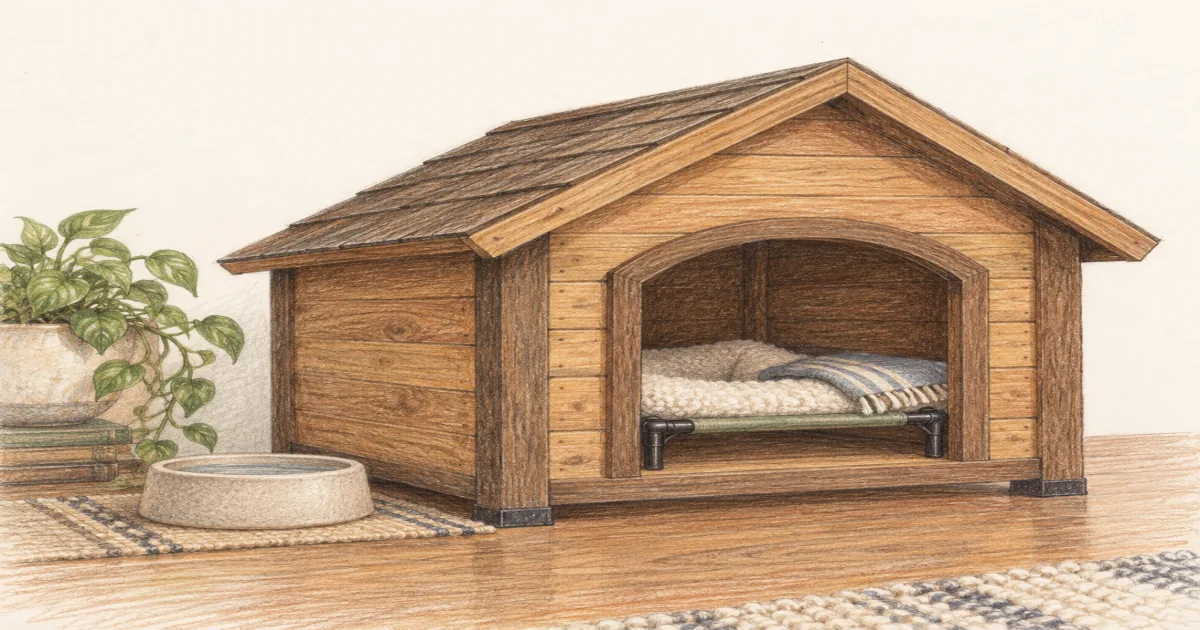
Best Dog House for Large Dogs (2026): Outdoor Shelter vs Indoor Den
Beds and crates
The best dog house for a large dog is the one the dog chooses on its own. Start with an elevated outdoor shelter for a dog that spends the day outside. Move to an indoor den or cave when the dog wants a warm, contained spot inside.
Our picks
The best dog house for most large dogs is the Veehoo Extra Large Dog House Outdoor when the dog spends real time in a yard, and an indoor den when it lives in the house. Either way, the house only earns its keep if the dog chooses it, and that comes down to three things: a floor off the ground, airflow in summer, and a size that lets the dog stand up and turn around without wedging itself in.
Get those right and the house becomes the spot the dog picks on its own. Get them wrong and you have an expensive planter.
Start with the beds and crates guides if you are still deciding between a house, a crate, and a bed. A crate is for travel and house training, so treat the best dog crate pillar as the indoor confinement guide, not a shelter. For a dog that just needs joint support indoors, the best orthopedic dog bed is the cheaper answer, and a raised outdoor bed covers a covered porch. If the animal is a cat, use the best outdoor cat house instead.
What a large-dog house has to get right
The floor matters more than the walls. A raised cot keeps a big dog off damp concrete, hot pavers, and cold ground, which is where most outdoor discomfort starts. Solid walls trap heat in summer and hold damp in winter.
Airflow is the second job. A large dog runs hot, and a closed plastic box with one small door turns into an oven by noon. Mesh panels you can open and close do more for a dog than thick insulation.
Then comes size. A house that is too small forces the dog to sleep curled against a wall. A house that is far too big never warms up in winter. Match the interior to the dog's length plus a few inches.
Top pick for outside: Veehoo Extra Large Dog House
The Veehoo Extra Large Dog House Outdoor is the best dog house for large dogs that spend real time outside. It is a raised cot with a weatherproof canopy over it, so the dog gets a bed and a roof in one frame. The 4.1 by 4.1 foot footprint holds one big dog or a pair of smaller ones.
The mesh windows are the quiet feature that earns the pick. Roll them up for cross-flow on a hot afternoon, then close the flaps when the weather turns. The canopy is water-resistant polyester, and ground stakes plus windproof buckles keep the whole thing anchored.
Skip it if you need a solid, insulated kennel for a hard winter, or if your dog shreds soft bedding for sport. This is a three-season shelter, not a heated cabin.
Best indoor den: Hovicaed Indoor Dog House, XL
The Hovicaed Indoor Dog House, XL 36x26 is the pick for a large dog that lives inside and wants a den. It is a soft-walled house with a high canopy, a supportive egg-crate foam base, and a cover you can pull off and wash.
This is the one to buy for a senior dog that has stopped liking the floor. The raised foam gives joints something to push against, and the contained shape cuts the visual noise of a busy room. Owners of 50 pound dogs report the dog fits with room to spare.
The tradeoff is durability. This is fabric over a light frame, not a chew-proof crate. If your dog has already destroyed a bed, put a heavy crate or a tough bed on the list instead.
Best soft cave: Pelemee Indoor Dog House, XL
The Pelemee Indoor Dog House, XL is the softest of the three and the best fit for a dog that likes to tuck in. The 29 inch cube gives a medium or large dog room to curl, and the flannel exterior has a subtle glow-in-the-dark star print that acts like a nightlight in a dark room.
The reversible cushion is the practical part. One side is warmer for winter, the other is cooler for summer, and the cover comes off for washing. The PVC frame runs the full perimeter, so the walls do not sag onto the dog.
Choose this for an anxious dog that hides under furniture, or for a bedroom corner where you want something softer than a crate. Skip it for a dog that chews fabric or a dog over the size range.
Outdoor house vs indoor den vs crate
Sizing a house for a 60 to 100 pound dog
Measure the dog first: nose to tail, and floor to the top of the head. Add 6 to 12 inches to the length, then check the interior numbers on the listing against that figure. A dog should stand up without ducking and turn around without hitting a wall.
- 60 to 75 pounds: roughly a 36 to 42 inch interior. The Hovicaed XL sits here, and the Veehoo has room to spare.
- 75 to 100 pounds: roughly a 42 to 49 inch interior. The Veehoo is the fit; most indoor caves stop short.
- Over 100 pounds: measure carefully and size up. Most fabric houses are not built for a giant breed.
A raised floor and a washable cushion matter more than wall thickness for a dog that lives indoors. For an outdoor dog, anchoring and airflow matter more than looks.
Mistakes that make a dog house go unused
- Buying too big. A house that is far larger than the dog never warms up in winter, and the dog goes back to the porch.
- Setting it on bare ground. A raised floor keeps the bed dry. On dirt, moisture wicks straight up.
- Facing the door into the wind. Point the opening away from the prevailing weather and add a windbreak.
- Skipping the bedding. A bare floor is not a bed, even under a roof.
- Ignoring the dog's habits. If your dog already naps in a corner with its back to the wall, it wants a den, not a yard shelter.
Bottom line
The Veehoo Extra Large Dog House Outdoor is the best dog house for large dogs that spend real time outside, because the raised cot, the canopy, and the opening windows cover comfort and weather in one frame.
For a dog that lives indoors, the Hovicaed Indoor Dog House, XL gives an older or anxious dog a den with real joint support. The Pelemee Indoor Dog House, XL is the soft-cave pick for a dog that burrows. Measure the dog, match the floor to the dog's habits, and the house will get used.
Frequently Asked Questions
How big should a dog house be for a large dog?
Give the dog room to stand without its head touching the roof, turn around, and lie flat. As a rule, the floor should be at least the dog's nose-to-tail length plus 6 to 12 inches. A 60 to 100 pound dog usually wants an interior around 40 to 49 inches across. A little extra headroom is fine, but a vast empty house holds less body heat in winter.
What is the best extra large dog house for outside use?
The Veehoo Extra Large Dog House Outdoor is the pick for most yards. It pairs a raised 49 x 33 inch cot with a weatherproof canopy, mesh windows, and ground stakes. You get shade, airflow, and a dry bed in one piece, and it moves or rinses clean without much fuss.
Are dogs happier inside or outside a dog house?
Most dogs want a den to retreat to, not a house to live in. A large dog that spends the day outside will use a shaded, raised shelter to cool off and nap. A dog that lives indoors usually wants a contained indoor den or cave bed more than an outdoor build. Watch where your dog already naps and match that spot.
Is there a large insulated dog house available?
Yes. Wooden shelters with sloped roofs and raised floors hold warmth better than a canopy tent, but most of the insulated models on Amazon top out around 65 pounds and cost more than the tent-style picks here. For a cold-climate dog, a wooden house in a wind-blocked spot with a raised floor and thick bedding is the safer setup.
Do large dogs need a dog house with a raised floor?
A raised floor is the single biggest comfort win. It keeps the dog off cold, wet, or hot ground, and it lets air move underneath so the bed dries after rain. The Veehoo cot does this by design. For an indoor den, the egg-crate base on the Hovicaed serves the same purpose on a hard floor.
Can a dog house be used indoors?
Yes, and for many large dogs an indoor den is the better buy. The Hovicaed and the Pelemee are both indoor houses: a contained shape with a washable cushion. They work well for older dogs that struggle on smooth floors and for anxious dogs that want a wall behind them.
How do I keep an outdoor dog house dry in rain?
Stake it or weigh it down, face the opening away from the prevailing wind, and keep the floor raised off bare ground. Clear the canopy after a storm and let the bed air out in the sun. A water-resistant canopy handles drizzle. For heavy, driving rain, add a windbreak or move to a wooden shelter with a solid roof.
What size dog house fits a 70 pound dog?
Aim for an interior at least 40 inches long and tall enough for the dog to stand upright. The Veehoo at 49 x 49 x 39 inches fits a 70 pound dog with room to spare. The Hovicaed XL is built for roughly a 50 pound dog and up. For a dog over 80 pounds, measure the actual interior before you buy and size up when the numbers sit on the line.