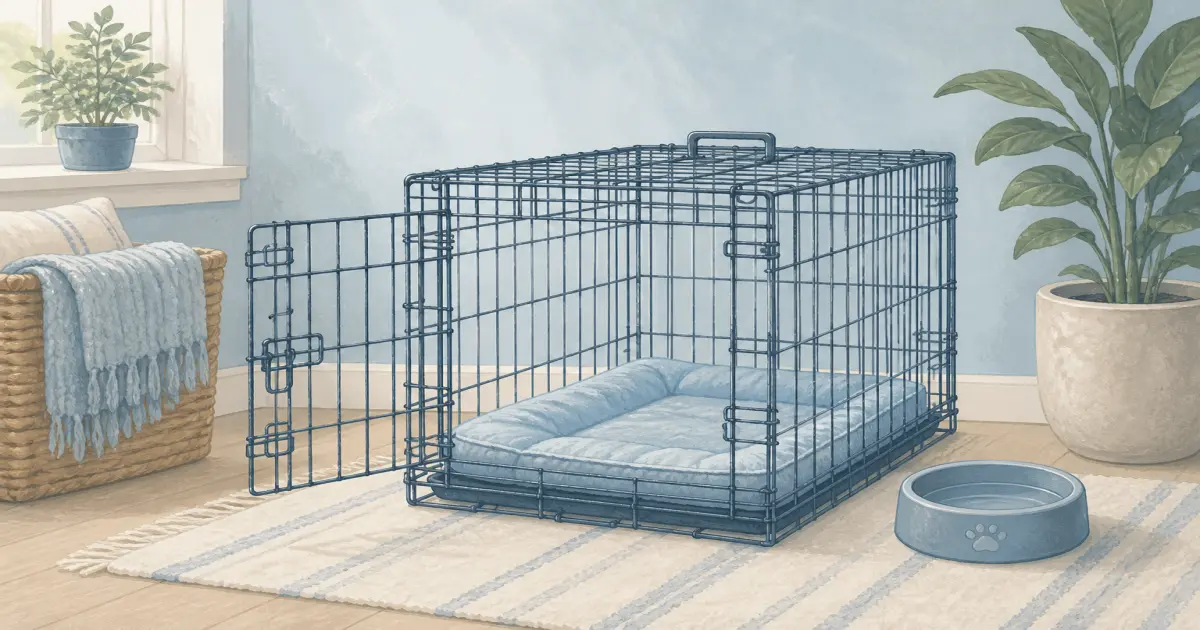
Best Dog Crate (2026): Right Size, Wire vs Plastic, and Training Picks
Beds and crates
The best dog crate is the one sized to the adult dog, with a latch that survives real anxiety and a pan you can actually wash. Start with the MidWest LifeStages double-door wire for training, the MidWest iCrate single-door for smaller everyday setups, and the Petmate Vari when travel needs a hard plastic shell.
Our picks
The best dog crate is the one your dog can stand and turn in as an adult, with latches that survive real anxiety, and a pan you can actually wash. Wire crates breathe and fold. Plastic kennels feel more den-like and meet many travel rules. Size to the adult dog first, then use a divider while you house-train a puppy.
Start in beds and crates if you are still deciding between dens, playpens, and carriers. For daytime floor space instead of a den, see best dog playpen. For hand-carry and cabin travel shells, see best dog carrier. Furniture-style hides live in best dog crate furniture. Add a washable crate pad once chewing settles. After surgery, a dog cone is a different tool than a den. Walk waste still needs dog poop bags, not a prettier crate.
If the dog lives outside instead of in a crate, the best dog house for large dogs guide covers raised outdoor shelters and indoor dens.
Crate size: the single biggest mistake
Most crate problems start with size. A crate that fits the eight-week photo is too small for the adult dog. A crate that fits the adult dog is too big for the puppy. Solve both with a divider.
Why the eight-week photo size fails
A crate bought for the puppy you brought home is a crate you replace in three months. The puppy grows through seven or eight sizes in its first year, and every size it outgrows is money you do not get back. Buy the adult size once and use the divider to shrink the living space, which is the whole reason the panel ships in the box.
How the divider cadence actually works
Set the divider so the puppy has only enough room to stand, turn, and lie down. Slide it back every 4 to 8 weeks through the first year, then take it out when the dog fills the crate. Extra space beyond about 6 to 8 inches in any direction tells the puppy it can sleep at one end and toilet at the other, which slows house training instead of speeding it up.
The standard sizing rule: the dog should be able to stand without hitting the top of the crate, turn around without scraping the sides, and lie down on its side. For a 50-pound adult dog, that is usually a 42-inch wire crate like the MidWest LifeStages. For a 25-pound adult, the MidWest iCrate in the 30 to 36 inch range is the typical answer.
Measure the dog before you buy. The adult weight on a breed chart is a guess. Two dogs of the same breed can be a full size apart. The crate is sized to the dog standing in the room, not the dog on the breeder's website.
For a puppy, buy the adult-sized crate and use the divider. The puppy only has room to stand, turn, and lie down. Expanding the space too early slows house training because the puppy learns to use one corner as a toilet and the other as a bed. Move the divider forward as the puppy grows, and remove it when the dog fills the crate at the adult size.
Wire vs plastic vs heavy-gauge wire
Wire crates breathe and fold flat. They are easier to clean than plastic because the pan slides out and the wire rinses off. They are also less den-like, which is fine for most dogs and a problem for dogs that need a covered retreat.
Plastic kennels feel more den-like and meet many airline policies. They are also bulkier to store and harder to move once assembled. Use plastic for travel and wire for home training.
Heavy-gauge wire earns its price when the dog already bent an iCrate latch, when the dog is a powerful adolescent, or when the crate will live in a garage or travel setup that gets knocked around. If the problem is chewing the bars rather than leaning on the door, our chew-proof crate guide splits that job into the three tiers of resistance.
Crate size chart for adult dogs
Match the crate length to the adult weight, then confirm it against your own measurement. The chart below is the ladder most brands publish, cross checked against the picks in this guide.
The weight column is a starting point. Length and standing height decide the real fit, and a deep chested or long bodied dog can need the next size up at the same weight.
Which dog crate brand should you buy?
MidWest owns the home market for a reason: the iCrate and LifeStages lines carry more than 110,000 and 14,000 ratings respectively, so the failure modes are public rather than hidden. Petmate is the travel answer, not the training answer.
What the MidWest reviews honestly show
The high rating does not mean every unit is perfect. The recurring 1 to 2 star themes are rust on the tray frame over time, thinner wire than older units on the XL sizes, and occasional rough bar ends that need a file pass. All three are survivable. Check the crate when it arrives, run a hand along the inside bars, and file anything that catches.
Where heavy gauge wire earns its price
Heavy gauge wire like the LifeStages line earns its cost when a powerful adolescent leans into the door, when the crate lives in a garage or travels, or when a standard latch has already given out once. A calm adult dog in a correctly sized iCrate does not need it. The 42 inch LifeStages crate weighs about 40.7 pounds, and the 24 inch iCrate about 13.8 pounds, so the heavier line is also a two person lift.
Should a dog sleep in a crate every night?
Yes for most crate trained dogs, and it is normal rather than cruel. A crate is a den the dog can choose, and most dogs sleep in one quietly for 7 to 9 hours once the routine is set. The crate stops being right when it is the only place the dog spends its day.
How many hours is too many
Overnight is fine. A full workday is not, for a young dog or a social breed, without a walk and a break in the middle. Use the crate for rest and for safety when you cannot supervise, and give the dog time out of it with the family every day. If the crate is where the dog lives rather than where it sleeps, the problem is the schedule, not the crate.
Which crate wins the three way comparison?
The three picks split by job, not by quality. Wire wins for home training, plastic wins for travel rules, and the heavy gauge line wins when a dog has already tested the door.
LifeStages by MidWest 42-Inch Double Door Crate uses a heavier wire gauge and dual doors. It is the training pick for large breeds in the 71 to 90 lb class when you want durability and a divider that shrinks the space for a puppy. Check the latches and the pan lock. Those are the parts that fail when a dog panics.
Midwest 24-Inch Single Door iCrate is the everyday wire crate for smaller dogs. Same basic MidWest pattern: divider, leak-proof pan, fold-flat design. The review count is enormous. Size carefully. An undersized crate frustrates dogs. An oversized crate slows house training if you skip the divider.
Petmate Vari Dog Kennel is the hard-sided travel pick. The 28-inch size suits small to medium dogs, and it is heavier to store, but it is what many car and airline setups expect. Ventilation and a secure door matter more here than fold-flat convenience.
Field notes from our crate training
How to measure before you click buy
- Measure your dog standing: floor to top of head or ears, plus a couple of inches.
- Measure nose to base of tail for length.
- Prefer manufacturer adult-weight charts over "breed guess" marketing.
- If you are between sizes, size up and use the divider for puppies.
A crate that is only comfortable for the eight-week photo will be replaced in three months. That is wasted money and another training reset.
Training basics that make the crate work
Feed meals in the crate with the door open at first. Short closed-door naps beat long panic sessions. Never use the crate as angry punishment after a mess. Pair it with calm exits and a consistent potty schedule.
If your dog screams for an hour, you have a training plan problem, not a crate brand problem. Fix duration and enrichment before you buy a third crate. For the walk itself, a best no pull dog harness is a different tool than a den.
When heavier gauge is worth it
Buy LifeStages-style heavier wire when your dog already bent an iCrate latch, when you have a powerful adolescent, or when the crate will live in a garage or travel setup that gets knocked around. Everyday calm adult dogs often do fine on the standard iCrate line if the size is right.
Travel notes without the scare tactics
Confirm airline crate rules before you fly. Hardware, size, and absorbent bedding requirements vary. For road trips, strap a plastic kennel or secure a wire crate so it cannot slide. Never leave a dog sealed in a hot car because the crate "keeps them safe."
Bedding, pans, and the mess reality
Use a washable pad that cannot bunch into a chew toy if your dog shreds fabric. Keep a second pad for laundry day. The leak-proof pan is there for accidents, not as a reason to skip potty breaks.
If urine sits in the pan, rust and smell follow. Wipe the pan when you wipe the floor. That boring habit keeps a 4.7-star crate from smelling like a shelter aisle.
Escape artists and anxious dogs
Dogs that bend latches need heavier wire, better latch discipline, and a training plan, not a prettier Amazon photo. Double-check slide bolts every time you leave. Some owners add a crate-grade clip on the latch for heavy chewers. If your dog still forces doors, talk to a trainer before you escalate to more metal.
Separation anxiety is not solved by a thicker gauge alone. The crate can be part of a plan. It is not the whole plan.
Where to place the crate
Quiet corners beat the middle of a noisy hallway. Dogs still need to see family life enough that the crate does not feel like exile. Avoid direct sun, heating vents, and damp basements. Give enough room to open the door fully so you are not fighting furniture every exit.
In small apartments, a fold-flat MidWest wire crate is worth it because you can collapse it when guests arrive. Plastic kennels usually stay assembled.
Housebreaking beside the crate? Keep disposable best dog pee pads for supervised floor stations, not as a soaked crate liner that teaches the dog to sleep in wet bedding.
What is the safest crate for a dog?
The safest crate is one that is sized correctly, assembled fully, and used in the right place. For the car, that means an anchored, crash tested carrier rather than a loose crate on the bench. For the home, a correctly sized wire crate with a locked pan and secure latches is enough for almost every dog.
What crash testing means for a car crate
An unrestrained crate becomes a projectile in a hard stop, and that is true of every material. The AVMA and the Center for Pet Safety both point to a crash tested carrier or harness for travel rather than assuming any crate qualifies.
If you fly, the rules change again. Cargo holds want a rigid, hard sided kennel with the halves bolted rather than clipped, and a door with a spring loaded lock that fastens all the way around. A home wire crate never meets that bar, and neither does anything soft sided. A plastic kennel that is not crash tested also does not meet it, so do not let the material alone reassure you.
What crate syndrome actually means
Crate syndrome is the pattern of a dog that panics inside a crate and hurts itself getting out, often by pushing at the door until the bars bend or a paw or jaw catches. It is a training and anxiety problem, not a hardware problem, which is why a thicker gauge alone rarely fixes it.
The usual help is a slower introduction, shorter sessions with the door open, feeding meals inside, and a cover on the wire so the den feels enclosed. If the dog hurts itself, bring in a trainer. A different enclosure, including a playpen for daytime, is often part of the answer.
How much does a dog crate cost to own?
A crate is a one time buy for most homes, so the cost per year is small. The line items that surprise people are the pan, the cover, and the pad, which wear out long before the frame does.
Run the frame over a dog's life and the crate is the cheapest piece of gear you will buy: a 24 inch iCrate near $31 across eight years is under $4 a year. The pad and the cover cost more over the same stretch, so buy those for washability rather than for looks.
Bottom line
The best dog crate for home life is usually a MidWest wire crate with a divider. Choose the LifeStages by MidWest 42-Inch Double Door Crate for larger, stronger dogs and the Midwest 24-Inch Single Door iCrate for smaller everyday setups. Add the Petmate Vari Dog Kennel when travel needs a hard shell. Size to the adult dog first, then pick the frame style.
Frequently Asked Questions
What is the best dog crate for most homes?
A MidWest wire crate with a divider is the usual answer. Use the LifeStages by MidWest 42-Inch Double Door Crate for larger, stronger dogs, or the Midwest 24-Inch Single Door iCrate for smaller breeds. Choose the Petmate Vari Dog Kennel when travel rules need plastic.
How do I size a dog crate?
Size to the adult dog. Your dog should stand without hitting the top, turn around, and lie on their side. Use the divider while potty training a puppy in an adult-sized crate.
Are wire crates safe for puppies?
Yes when assembled correctly with the pan locked and latches secured. Watch paws on wide wire gaps and move to a different style if your puppy is an escape artist.
Do I need a double-door crate?
Side doors help in cars and tight rooms. A single front door is fine in an open living room.
Should I cover the crate?
A breathable cover can calm some dogs. Never block airflow or use a cover as a substitute for training.
Wire or plastic for airline travel?
Many airlines require a hard-sided kennel that meets IATA-style hardware rules. Confirm your carrier's crate policy before you fly. Home training can still use wire.
What crate size for a growing puppy?
Buy the adult size and use the divider so the puppy only has room to stand, turn, and lie down. Expanding space too early slows house training.
What size crate for a 50-pound dog?
A 42-inch crate is the typical answer for a 50-pound adult. Measure the dog's standing height and length first. The dog should be able to stand without hitting the top of the crate.
How heavy should a crate be for a strong dog?
Heavier-gauge wire like the MidWest LifeStages holds up to large, strong dogs that lean into the door when anxious. Standard iCrate wire is enough for calm adult dogs that do not test the door.
What is the best crate for crate training a puppy?
An adult-sized wire crate with a divider is the standard answer. The puppy gets only enough room to stand, turn, and lie down. Move the divider as the puppy grows. Wire breathes, folds flat, and is easier to clean than plastic for house training.
Can a dog crate be used as a dog bed?
Yes for calm adult dogs that already see the crate as a den. Puppies and anxious dogs need the door open and the crate positioned near family life. Skip loose bedding with heavy chewers until the crate is calm.
Do I need a crate pad?
A washable crate pad helps for naps if your dog does not shred bedding. Skip loose blankets with heavy chewers until the crate is calm.