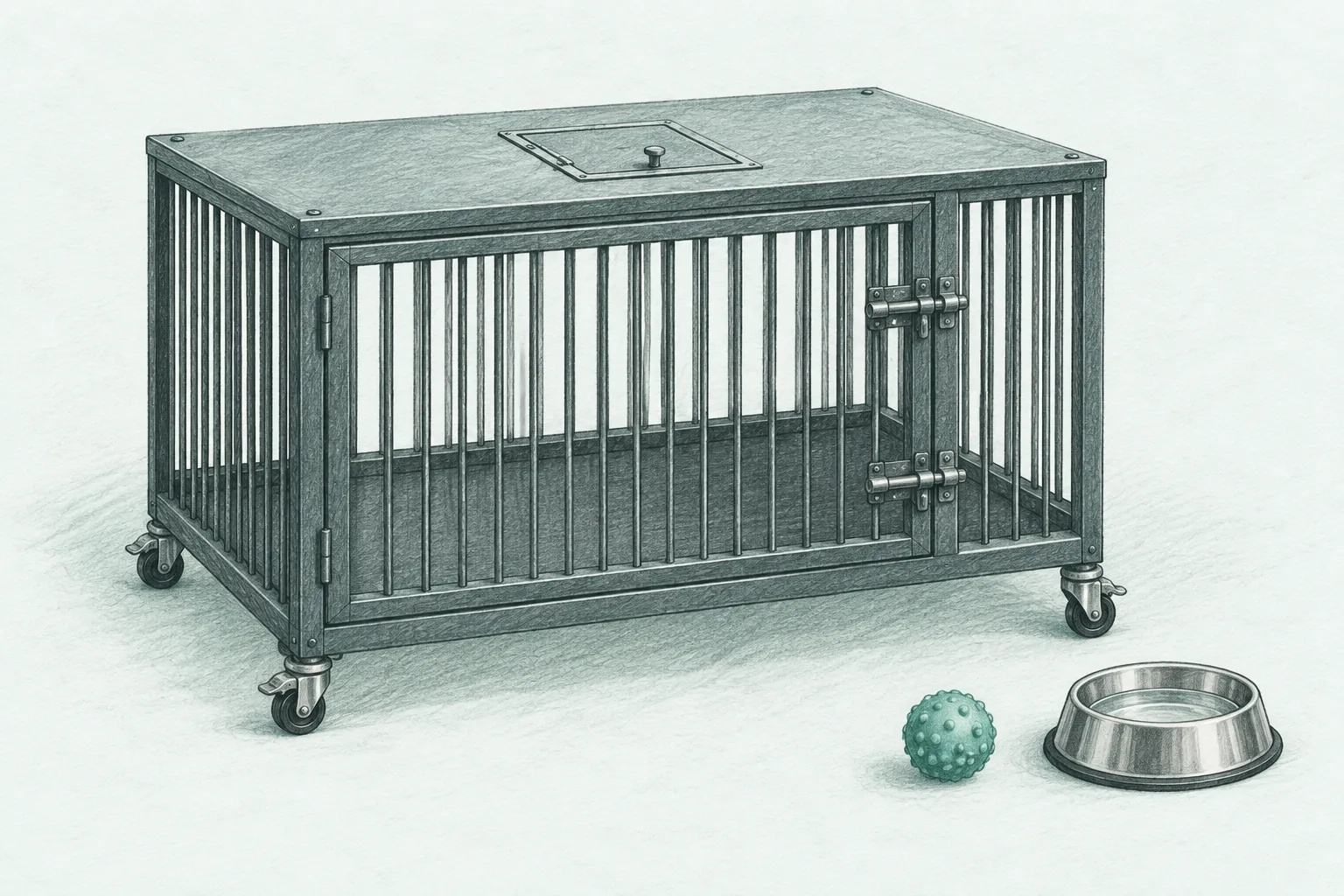
Best Dog Crate for Chewers (2026): Three Tiers of Chew Resistance
Beds and crates
The best dog crate for chewers depends on whether your dog has already bent a bar. Heavy-gauge steel is the answer for a dog that has beaten wire, a standard folding crate is still the right buy for a dog that only scratches the door, and a 42-inch double-door crate is the budget middle.
Our picks
The best dog crate for chewers is not the one with the loudest "indestructible" label. It is the one that matches how far your dog has already gone. A dog that noses the door and chews the latch needs a better latch. A dog that has bent a wire panel needs steel tubing. Those are two different crates at two very different prices.
Start with the family guide to dog crates if you are still choosing between wire, plastic, and heavy steel, and browse beds and crates for the rest of the setup. Once the chewing settles, a washable crate pad is the next thing that survives a determined dog.
What actually stops a chewer?
A better crate only helps when the motive is escape. If the motive is anxiety, the dog will work on whatever you put in front of it, including a steel crate. VCA animal hospitals name both motives in the same breath, and the distinction matters more than the gauge.
Why "indestructible" is a label, not a spec
The word is marketing. What you can actually compare is the tube diameter, the joint type, the latch position, and the floor rating. A listing that gives you 0.8 inch tubes, welded joints, dual latches, and a 500 pound floor grate is telling you something. A listing that says "chew proof" and nothing else is not.
That is not a knock on cheap crates. Folding wire is the right answer for most dogs. It is the wrong answer for the dog that already beat one.
The three tiers of chew resistance
Most chewers belong in the first or second row. The third row is a small group of dogs, and it comes with an owner problem as much as a dog problem.
Is there a crate a dog cannot chew out of?
No. The honest answer is that no crate is destruction proof. What changes between tiers is how long the crate holds and how much noise it makes while it does. A determined dog with untreated separation anxiety can damage steel too, and it can injure itself on the attempt.
What bar specs actually tell you
The Midwest 30-inch iCrate publishes a wire gap of 37.5 millimetres, which is about 1.48 inches, plus a slide-bolt latch with a Paw Block to stop the door being nosed open from inside. Those two numbers are the ones worth comparing against your dog's muzzle width and its habit of working latches.
The LEMBERI heavy-duty crate takes a different approach. Its bars are 0.8 inch steel tubes, roughly the diameter of a marker, with welded joints and dual latches on the front and top doors. When a 70 pound dog throws its weight at a door, tube diameter and joint type are what decide whether you are buying a second crate in six weeks.
Why your dog's jaw finds folding wire
A wire panel flexes. Flex is the whole point of a fold-flat crate, and it is also the weakness a chewer finds. Once a panel bows even slightly, the gap widens and the dog gets more purchase on the next attempt. That is the feedback loop that turns a mild door-scratcher into a dog that has bent a bar.
Best heavy-duty pick: LEMBERI 42-inch steel crate
The LEMBERI 42 Inch Heavy Duty Indestructible Dog Crate is the crate to buy when wire has already failed. It is 20-gauge steel with 0.8 inch reinforced tubes, welded joints, and dual high-strength latches with safety buckles, which is a different class of hardware from a folding panel.
The dimensions are 42.5 by 29.9 by 34.5 inches with a 35 inch interior height, so it suits a dog that needs to stand and turn in the 41 to 70 pound range. It ships at about 88 pounds and is meant to live in one spot, which is the actual tradeoff. You are not folding this one into a closet.
Two details earn it the top slot. First, the top door. Feeding through the skylight door without opening the main door keeps a food-motivated chewer from rehearsing the escape every night. Second, the floor. A removable wire grate sits over a leak-proof slide-out tray, so waste drops through the grate and the tray comes out for cleaning without tools. Some dogs need a week to get comfortable standing on a grate rather than a plush pad.
Skip it if your dog has never damaged a crate. You will pay three times the price of folding wire for resistance you do not need yet.
Best for mild chewers: Midwest 30-inch iCrate
The Midwest 30-Inch Single Door iCrate is the right crate for the much larger group of dogs that scratch and nose at the door but have never bent a bar. It is standard-gauge metal with a black e-coat finish, a slide-bolt latch with a Paw Block, rounded corner clips, a leak-proof tray, and rubber feet.
At 30.67 by 19.3 by 21.46 inches and 17 pounds, it is sized for 21 to 40 pound dogs, so a French Bulldog, a Welsh Terrier, or a Dachshund. The company itself suggests sizing up to the 36-inch model for dogs near 40 pounds, and that is good advice rather than marketing filler.
The divider panel is the part people underestimate. Buy the adult size once and shrink the living space with the panel while the dog is young. The 110,839 ratings on this line are not per-size, because the iCrate sizes share one pool of reviews, but they are why the common complaints are public rather than hidden: rough bar ends on arrival, thin wire on the largest sizes, and tray-frame rust after a couple of years.
Treat this as the crate you buy when the chewing is behavioural noise rather than a structural problem.
Best budget double door: Sweetcrispy 42-inch
The Sweetcrispy Dog Crate 42 Inch is the middle rung. It is a foldable wire crate at 42.5 by 26.8 by 29.1 inches with front and side doors, two heavy-duty sliding bolt locks, thick metal mesh, and rounded edges rather than bare wire ends.
The 42 inch length covers the 41 to 70 pound band, which is where a lot of adolescent chewers sit before they are fully grown. The fold-flat frame is what makes it work in an apartment or a spare room that has to serve another purpose when guests arrive.
At $53.92 it is less than half the heavy-duty crate, and two of them still cost less than one steel crate. That is the honest budget case: buy this one for a dog that has never damaged a crate, and put the savings toward a trainer if the chewing turns out to be anxiety rather than boredom.
How much does a chew-proof crate cost to own?
A crate is a one-time buy, so the yearly number is small next to the price on the page. The number that surprises people is cost per pound, because steel is sold by weight as much as by size.
The middle column shows the tradeoff. You pay the least per pound for the heavy-duty crate and the most for the small folding one, because you are buying the steel that resists a determined dog. If the dog never tests the crate, that steel is money you did not need to spend.
Then price the replacement. A dog that bends a $40 folding crate every few months is not a cheap dog to crate, and the second crate plus the ruined bedding usually costs more than the steel one would have.
How do I stop the chewing, not just survive it?
Buying steel without changing the routine is how people end up with a dog that beats the steel too. The crate is one part of the plan, and the smaller part.
Feed meals in the crate with the door open
Put the bowl inside and leave the door open for the first week. The crate becomes the place food happens rather than the place you disappear. For a food-motivated chewer, this is the single fastest change, and it is why the LEMBERI's top door is genuinely useful rather than a gimmick.
Keep closed-door sessions short at first
Two minutes, then five, then fifteen. A dog that panics for an hour has a training problem, not a crate problem. Lengthening the time slowly is what stops the door-chewing habit forming in the first place.
Never use the crate as punishment
A crate used after a mess or a bark becomes the room the dog wants out of, and a dog that wants out chews the door. Send the dog in with something to do, not as a consequence.
When to call a trainer
If your dog injures itself, cuts its mouth, or damages a paw working at the door, stop buying crates and call a trainer. That is the pattern people call crate syndrome, and it is an anxiety problem. A thicker crate makes the injury worse rather than better, because the dog works just as hard against something that will not give.
What size crate does a chewer need?
Size decides how much crate you are defending. A properly sized crate gives the dog room to stand, turn, and lie flat, and not much more.
Two points worth knowing before you order. Published dimensions are exterior, and the usable interior runs about 1 to 2 inches smaller per side, so a 42.5 inch crate gives you closer to 38 inches of floor. And a crate that is too big slows house training, because the dog learns to sleep at one end and toilet at the other.
When a furniture crate is the wrong buy
A wood-look crate that doubles as an end table looks better in a living room than steel, and that is its entire case. The frame is the weak point for a serious chewer, and the panels are not built to take a dog leaning on a door. They are fine for a mild chewer whose issue is bedding rather than bars.
If your dog shreds pads and blankets rather than working the door, the fix is a pad built for it, not a new crate. See the crate pad guide, and give a chewer something designed to be chewed instead of the furniture: an indestructible dog toy and a puzzle toy both beat a bare crate floor for a bored dog.
Bottom line
Buy the LEMBERI 42 Inch Heavy Duty Indestructible Dog Crate if your dog has already bent or escaped a wire crate, because 0.8 inch steel tubes and dual latches are what actually stop that dog.
Buy the Midwest 30-Inch Single Door iCrate if the chewing is door-nosing and scratches, since $39.62 is the right price for a problem that is not structural yet. Buy the Sweetcrispy 42 Inch Dog Crate when you want two doors and a fold-flat frame and your dog has never damaged a crate.
Whatever you buy, fix the routine in the same week or the crate is the next thing your dog chews.
Frequently Asked Questions
What is the best dog crate for chewers?
The LEMBERI 42 Inch Heavy Duty crate is the pick for a dog that has already bent or escaped a wire crate, because the 0.8 inch steel tubes do not flex. If your dog only scratches at the door and has never damaged a bar, the Midwest 30-Inch iCrate at $39.62 is the smarter buy.
Is there a truly chew-proof dog crate?
No. There is a resistance ladder: folding wire, then 20-gauge steel with 0.5 to 0.8 inch tubes, then reinforced aluminium. Each tier costs more and buys more time, but a determined dog with untreated anxiety can still work at any of them.
Why does my dog chew the crate bars?
VCA animal hospitals list two main motives: trying to escape confinement, and chewing as an outlet for anxiety. Puppies between 3 and 6 months also chew for teething. Which one it is decides whether a new crate is even the right purchase.
What material will a dog not chew?
Nothing is chew-proof, but the materials that hold up are heavy-gauge steel tubing over folding wire, welded joints over clipped ones, and latches outside the dog's reach over latches inside the crate. Soft-sided fabric and plastic are the two fastest losses.
How do I stop the chewing, not just survive it?
Feed meals in the crate with the door open, keep closed-door sessions short, and never use the crate as punishment. If your dog injures itself trying to get out, that is crate syndrome and it needs a trainer, not a thicker gauge.
What is crate syndrome?
It is the pattern of a dog panicking inside a crate and hurting itself trying to escape, often by pushing until bars bend or a paw or jaw catches. It is an anxiety and training problem, and a heavier crate alone rarely fixes it.
What size crate does a chewer need?
Size to the adult dog: 30 inches for 21 to 40 pounds, 42 inches for 41 to 70 pounds, and 48 inches for 71 to 90 pounds. The dog should stand without hitting the top, turn around, and lie down flat.
Should I zip tie or padlock a crate to make it escape proof?
Most experienced owners advise against it. The ties and locks add something the dog can chew and an extra step in an emergency, and they do not fix a crate that was not built to hold a determined dog in the first place.
Is a furniture-style crate good for a chewer?
Not usually. Wood-look furniture crates trade strength for looks, and the frame is the part a power chewer attacks. They work for a mild chewer in a living room, not for a dog that has already beaten steel.
How much does a chew-proof crate cost to own?
The heavy-duty steel crate at $128.99 works out to $1.47 per pound of crate and about $16 a year across an 8-year dog life. The 30-inch folding iCrate at $39.62 is $2.33 per pound but only about $5 a year.