Best Wire Dog Crate (2026): Three Sizes That Hold Up
Beds and crates
The best wire dog crate for most large dogs is the Midwest 42-Inch iCrate, because a 37.5 mm bar gap and a Paw Block latch are the two specs that actually stop a dog. The 30-inch iCrate covers medium dogs for under $50, and the Amazon Basics 48-inch is the double-door pick.
Our picks
The best wire dog crate is the one whose bar gap, height, and floor size match your dog, not the one with the biggest marketing claims. A wire crate is a size ladder: 30 inches for 21-40 pounds, 36 inches for 41-70, 42 inches for 71-90, and 48 inches above that. Pick the wrong rung and you either buy twice or hand your dog a puzzle.
This page is only about folding wire crates. If you are still choosing between wire, plastic, and heavy steel, start with the family guide to dog crates, then browse beds and crates for the rest of the setup. Once the crate is home, a washable crate pad and a crate cover are the two additions that change how the dog settles.
What makes a wire crate different from plastic or soft?
Wire gives airflow, sight lines, and a fold-flat frame for the car. Plastic gives a darker den and is the only type most airlines accept. Soft-sided crates are for hotels and quiet dogs, not for a chewer or a dog that paws at the walls.
Wire for home, plastic for flights
The job decides the crate. A wire crate lives in one room, folds flat when guests arrive, and lets the dog watch the household, which is why it is the default for crate training at home. A plastic carrier is the travel crate, because it has a solid shell an airline will accept.
The mistake is buying one crate for both jobs. A wire crate does not protect a dog in a cargo hold, and a plastic carrier is heavy and closed-in for everyday use. Most households that travel end up with a wire crate at home and a separate carrier for the car or the plane.
The bar gap is the spec that matters
The Midwest 42-inch iCrate publishes a wire gap of 37.5 millimetres, which is about 1.48 inches. That is the number to compare against your dog's muzzle width if you have a puppy that likes to test the bars. A smaller gap is safer for a tiny breed; the same gap on a large crate is normal.
The other hardware detail is the latch. The iCrate uses a slide bolt with a Paw Block, a small U-shaped wire underneath the bolt that stops a dog reaching through and flipping it open from inside. It is a quiet feature, and it is the difference between a crate that holds and one that gets worked open on a bored afternoon.
Best overall: Midwest 42-Inch Single Door iCrate
The Midwest 42-Inch Single Door iCrate is the best wire dog crate for most large dogs. It measures 42.5 by 28.5 by 30.5 inches and is sized for the 71-90 pound band, which covers Australian Shepherds, Boxers, and most Golden Retrievers. The 35-pound frame is heavy enough to feel planted and light enough to fold and carry.
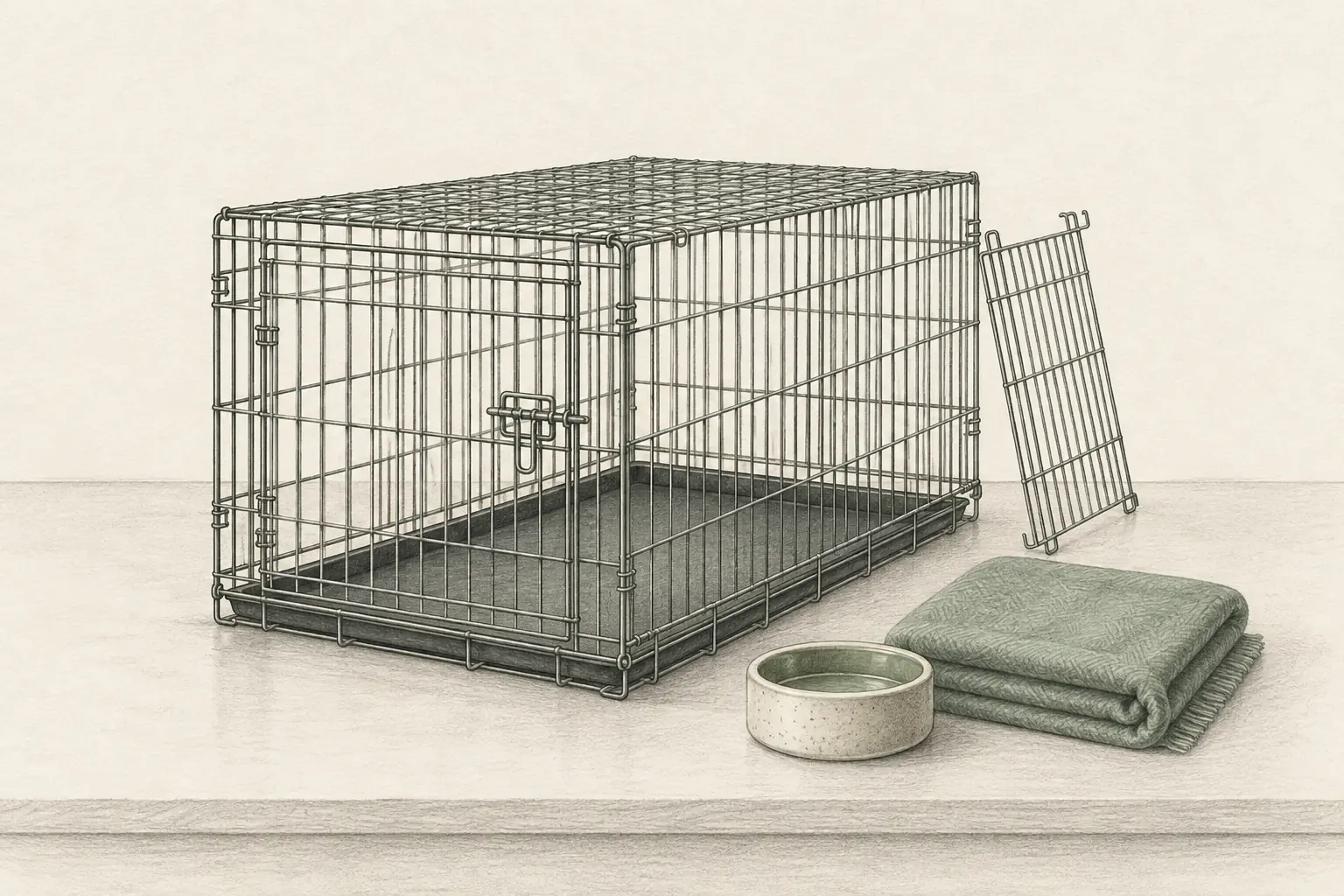
Two details put it on top. First, the hardware: a slide-bolt latch with the Paw Block, rounded corner clips, and a black e-coat finish that resists everyday wear. Second, the divider. You buy the adult size once and use the panel to make the space puppy-sized, then open it up as the dog grows. The brand's own advice is to size up to the 48-inch model for a dog near 90 pounds, and that is good guidance rather than filler.
The 110,831 ratings on this line are shared across the iCrate sizes, so read them as a line average rather than a per-size score. That is also why the common complaints are public: thin wire on the largest sizes and tray-frame rust after a couple of years. Neither is a reason to skip the crate for a normal dog. Both are reasons to wipe the tray and not to hang a 90-pound dog on the door.
Best double door: Amazon Basics 48-Inch
The Amazon Basics 48-Inch Double Door is the pick when the crate needs to fit a corner or the dog is at the top of the large range. It measures 48 by 30 by 32.5 inches and is intended for dogs that fit inside about 46 by 28.5 inches, so a German Shepherd, a Rottweiler, or a Bernese. It ships with a divider panel, a removable tray, and a top carry handle.
The double door is the whole point. A single-door crate against a wall leaves you leaning across the dog to reach the latch; a side door solves that. Both doors use manual slide-bolt locks, which are simple and repairable. The tray hook keeps the pan from creeping out during use, and the metal construction folds flat for storage.
At $100.64 and 43.3 pounds, it is the lowest cost per pound of the three picks, and it is the one to choose if the dog is XL or the room is tight.
Best for medium dogs: Midwest 30-Inch iCrate
The Midwest 30-Inch Single Door iCrate is the best wire dog crate for a 21-40 pound dog: a French Bulldog, a Beagle, a Welsh Terrier, or a Dachshund. It measures 30.7 by 19.3 by 21.5 inches and weighs 17 pounds, which is light enough to carry in one hand and fold flat for the car.
It uses the same hardware family as the 42-inch: a slide-bolt latch with the Paw Block, rounded corner clips, a leak-proof tray, rubber feet, and a divider panel. The difference is scale. There is less steel, so it costs less to buy and less to own, and it is the right answer for a smaller dog that does not need a large crate's footprint.
Skip it if the dog is near or over 40 pounds, or if the dog has already bent a crate. For that dog, size up to the 36-inch iCrate or step into a heavy-duty steel crate, which is a different job.
How big a wire crate does my dog need?
Size to the adult dog, not the puppy. The dog should be able to stand without its head touching the top, turn around without crouching, and lie down flat with a few inches spare. If the crate is much bigger than that, house training gets harder, not easier.
Measure stand, turn, lie flat
Measure your dog standing at the shoulder and lying nose to tail, then add a couple of inches to each. A dog that has to duck into a crate will avoid it; a dog with room to stand will settle. The crate length you buy should be the dog's body length plus 2 to 4 inches, and the height should clear the standing dog by 2 to 4 inches.
Usable floor is smaller than the label
Published crate sizes are exterior measurements, and the usable interior runs about 1 to 2 inches smaller per side. A 42.5-inch crate gives closer to 38 inches of actual floor, and a 48-inch gives about 44. That matters most for long-bodied dogs, where the exterior number looks generous but the inside is tight.
How much does a wire crate cost to own?
A crate is a one-time buy, so the yearly cost is small. The number that surprises people is cost per pound, because wire crates are sold by size and steel is sold by weight. Paying more per pound usually means paying for thinner wire in a smaller crate.
Cost per pound and per year
The Amazon Basics 48-inch is the best value per pound of crate, because you get the most steel for the money. The 30-inch iCrate is the most expensive per pound and the cheapest per year, because there is simply less crate to own. Neither number is a quality score. They tell you what you are paying for: steel, not brand.
The other cost to weigh is replacement. A dog that bends a $50 folding crate every few months is not a cheap dog to crate, and the second crate plus ruined bedding usually costs more than one heavy-duty steel crate would have.
Single door or double door?
Single door is fine for most homes, and it is the cheaper crate. Double door is worth it when the crate sits in a corner or against a wall, or when you want a second access point for feeding and bedding without opening the main door. Neither is more secure than the other; the latch hardware is the same.
If you are unsure, look at where the crate will live. A crate against a wall with only the front exposed needs one door. A crate wedged into a corner, or one that has to serve a hallway and a bedroom, is easier to live with as a double door.
When a wire crate is the wrong crate
A wire crate is the wrong buy for three dogs. A dog that has already bent or escaped a wire crate needs heavy-gauge steel, which is a different product at a higher price. A dog that panics and injures itself working at the door has an anxiety problem, and a thicker crate makes the injury worse rather than better. And a dog that flies regularly needs a hard plastic carrier, not wire.
Wire is also the wrong crate for a dog that lives outdoors. The e-coat finish resists everyday wear indoors, but a crate that sits on a damp patio will rust at the tray frame faster than you would expect. Keep a wire crate inside, and use a kennel or a covered run for outdoor time.
Bottom line
Buy the Midwest 42-Inch Single Door iCrate if you have a 71-90 pound dog and want the best wire dog crate with a published bar gap, a Paw Block latch, and a divider that grows with a puppy.
Buy the Amazon Basics 48-Inch Double Door if the crate goes in a corner or the dog is at the top of the size range, since two doors and the lowest cost per pound are the reasons to choose it. Buy the Midwest 30-Inch Single Door iCrate if the dog is 21-40 pounds and you want a crate you can carry one-handed.
Whatever you buy, size it to the adult dog, wipe the tray, and add a pad before the first night. More gear lives on the blog and the homepage when the setup needs finishing.
Frequently Asked Questions
What is the best wire dog crate?
For most large dogs, the Midwest 42-Inch Single Door iCrate is the pick, because it publishes a 37.5 mm bar gap and ships a Paw Block latch that stops a dog flipping the door open. For a 21-40 lb dog, the 30-inch iCrate is the smarter, lighter buy.
Is a wire crate good for a dog?
Yes for home use. Wire gives visibility and airflow, and the fold-flat frame moves easily. It is not the crate for a dog that has already bent a bar, and it is not the crate for air travel, where a hard plastic carrier is the requirement.
What size wire crate does my dog need?
Size to the adult dog: 30 inches for 21-40 pounds, 36 inches for 41-70 pounds, 42 inches for 71-90 pounds, and 48 inches for larger. The dog should stand without touching the top, turn around, and lie down flat with a little room spare.
Are wire crates or plastic crates better?
Wire is better at home, where airflow and sight lines matter and the crate lives in one spot. Plastic is better for flights and for a dog that needs a darker den. Most households that do both own a wire crate plus a separate travel carrier.
How much does a wire crate cost to own?
The 42-inch iCrate at $93.99 works out to $2.69 per pound of crate and about $11.75 a year across an 8-year dog life. The 30-inch at $49.99 is $2.94 per pound but only about $6.25 a year, because there is less steel to buy.
What is a Paw Block on a dog crate?
It is the small U-shaped piece of wire under the slide-bolt latch on a MidWest iCrate. It stops a dog reaching through the bars and flipping the bolt open with a paw, which is the most common way a wire crate gets defeated.
What gauge wire are dog crates made of?
Folding wire crates use standard-gauge panels, while heavy-duty crates step up to 20-gauge steel with 0.5 to 0.8 inch tubes. Wirecutter bent wire-crate panels outward at about 50 pounds of force, so gauge is a resistance rating rather than an escape-proof guarantee.
Do I need a divider panel?
For a puppy, yes. Buy the adult size and use the divider to shrink the living space while the dog is small, then remove it as the dog grows. That is cheaper than buying a small crate first and a large one later.