Best Compact Automatic Litter Box (2026): Small-Footprint Picks
Litter boxes
The best compact automatic litter box is the OneBug Self Cleaning Open Top for tight bathrooms: 20.6 inches long and 15.7 inches wide, with no app to set up. The otoging open-top box is the value pick when you want a bigger bin for less.
Our picks
The best compact automatic litter box is the OneBug Self Cleaning Open Top when floor space is the real constraint. Every automatic box is a chunk of plastic, but the useful question is how narrow it is and how low the entry sits. This one is the narrowest of the open-top group, and it skips the app entirely.
The otoging Self Cleaning Litter Box covers the value lane. It trades a little extra width for a bigger bin, a lower sticker price, and the same no-app simplicity.
Start with the litter box guides if you are comparing box types. The best automatic litter box pillar covers the full-size drum, globe, and crystal options, and the small space setup guide walks through clearance and placement. If more than one cat shares the box, the multi-cat guide covers capacity.
What makes an automatic litter box compact
Forget the marketing word and look at three numbers: width, length, and entry height. Width decides whether the box fits beside a toilet or between an appliance and a wall. Length decides whether the cat can turn inside without fighting the drum.
Entry height decides whether the cat will use it at all. A low, open top is easier for a senior cat, a small cat, or a nervous cat than a tall step into a tunnel. That is why most genuinely compact automatic boxes are open-top drums rather than enclosed globes.
The last number is clearance. You need room to slide the waste bin out and lift the drum for a rinse. A box that fits the gap but cannot be serviced will annoy you every week.
Top pick: OneBug Self Cleaning Open Top
The OneBug Self Cleaning Open Top is the best compact automatic litter box for most tight spaces. It is a drum that rotates to sift clumps into a sealed bin, with an open top and a low step-in lip.
The width is the headline. At 15.7 inches it fits gaps that full-size robots cannot, and it still gives a cat room to turn. The open top keeps an eye-line to the room, which helps cats that bolt out of tunnels.
The controls are one button. No app, no subscription, no network. The drum, waste bin, screen, and leak mat lift out without tools for a rinse. For a small apartment, that simplicity is worth more than remote alerts.
Best value: otoging Self Cleaning Litter Box
The otoging Self Cleaning Litter Box is the value pick. It uses the same open-top, no-app formula as the top pick, with a bigger waste bin and a lower price when it is discounted.
The capacity is the reason to choose it. A 10 L bin and a 6 kg litter capacity mean fewer top-ups in a busy week. The sealed bin and a cycle that runs a few minutes after the cat leaves keep odor and mess under control.
It is wider, so it suits a laundry room or a bathroom with a little more room. If your gap is truly narrow, stay with the OneBug.
Compact box vs full-size robot
The full-size robot wins on capacity and tracking. The compact box wins on where it can live. If two cats share the box and you have the floor, a bigger unit pays off. If the only free corner is 16 inches wide, a compact box is the one that gets used.
Fitting a compact box into a bathroom or laundry corner
Measure the gap first, then subtract an inch for the drum to clear the wall during a cycle. A box that rubs on the turn will stall or scuff.
Keep it on a hard, level surface. Carpet and soft rugs confuse the sensors and make the drum work harder. A firm floor also makes the weight readings steadier on boxes that track them.
Leave 12 inches of open space in front of the entry. Cats want a clear approach, and you want room to pull the bin without lifting the machine.
Keep the box away from the water heater, the dryer vent, and direct sun. Heat and humidity make odor worse and are hard on the electronics.
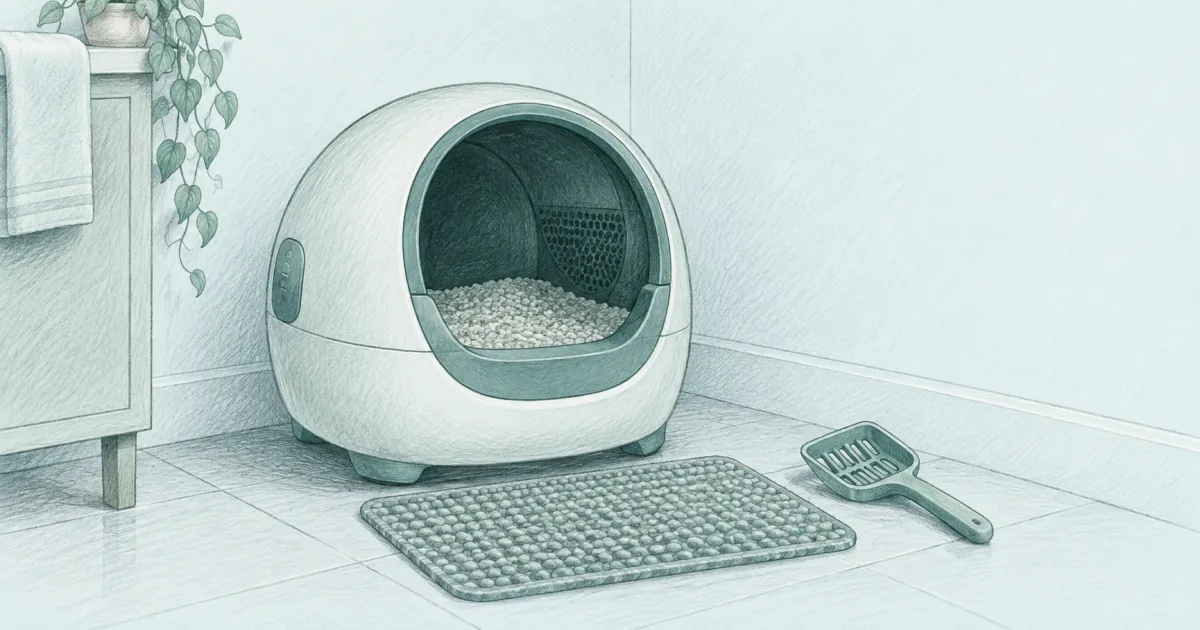
Put a mat at the exit. Open-top boxes throw more litter than enclosed ones, and a mat catches most of it before it reaches the hall.
Which cats a compact box does not suit
A very large cat can outgrow a compact drum. If your cat is over about 15 to 20 pounds, check the interior and the turning room before you buy, or step up to a full-size box.
A cat that will not use a drum at all needs a different mechanism. Some cats accept a rake or a tray far more readily than a rotating cylinder. If your cat has refused a self-cleaning box before, a manual high-sided pan may beat forcing the issue.
Households with three or more cats usually need two boxes, not one bigger one. Compact units also need more frequent emptying, so plan the schedule before you rely on one machine.
Bottom line
The OneBug Self Cleaning Open Top is the best compact automatic litter box for small apartments and tight corners. Its 15.7 inch width, low open entry, and no-app setup cover the jobs that matter when floor space is scarce.
Choose the otoging Self Cleaning Litter Box when you want a bigger bin and a lower price and have a few extra inches to spare. Measure the gap, keep the box on a hard floor, and add a mat at the exit. Do that and a compact box earns its corner.
Frequently Asked Questions
Which automatic litter box is the most compact?
The OneBug Self Cleaning Open Top is the most compact of the open-top boxes here at 20.6 by 15.7 inches. Its width is the useful number: 15.7 inches fits beside a toilet or between a washer and a wall. Most globe robots start around 22 inches wide, which is a different footprint class.
Is there a smaller Litter-Robot?
No. The Litter-Robot 4 is large by design, and Whisker does not make a smaller version. If you are tight on floor space, an open-top drum box is the realistic route. They trade the enclosed globe for a smaller frame and a lower entry, and most cost a fraction of a Litter-Robot.
What is the most reliable automatic cat litter box?
Reliability tracks the mechanism and the support behind it. A simple drum or rake with no app has fewer things to fail than a Wi-Fi box, and it still cleans after every visit. Sealed waste storage and a washable drum matter more than app features for day-to-day trust.
Do vets recommend automatic litter boxes?
Many vets are neutral on automation itself and focused on what affects the cat: a clean box, a low entry, and no stress around using it. An automatic box can help a household keep up with scooping, but it does not replace watching for changes in your cat's bathroom habits. Health tracking on an app is a bonus, not a diagnosis.
How much floor space does an automatic litter box need?
Budget about 2.5 to 3 square feet for the unit, then add clearance for the cat to enter and turn around. A compact open-top box needs roughly 21 by 16 inches of floor plus 12 inches of open space in front. Leave room to pull the waste bin out, or you will move furniture every time you empty it.
Do compact automatic litter boxes work for large cats?
Size the interior, not the outside. Most open-top drums here fit cats up to about 15 to 22 pounds, and a large cat needs room to turn without bumping the drum wall. A very big cat is usually better served by a full-size box, even if it takes more floor.
Do automatic litter boxes need an app?
No. Several open-top boxes run on a single button and a plug, with no app, no Wi-Fi, and no account. Skipping the app removes the pairing problems that send some owners back to a manual box. What you give up is remote alerts and use tracking.
How often do you empty a compact litter box?
Expect about a week for a single cat on a 10 L bin, and more often with two cats. Compact boxes have smaller bins than full-size robots, so trips are shorter. Check the bin daily at first, then settle into a rhythm based on fill level and smell.